
Viśrānti: The Sacred Pause
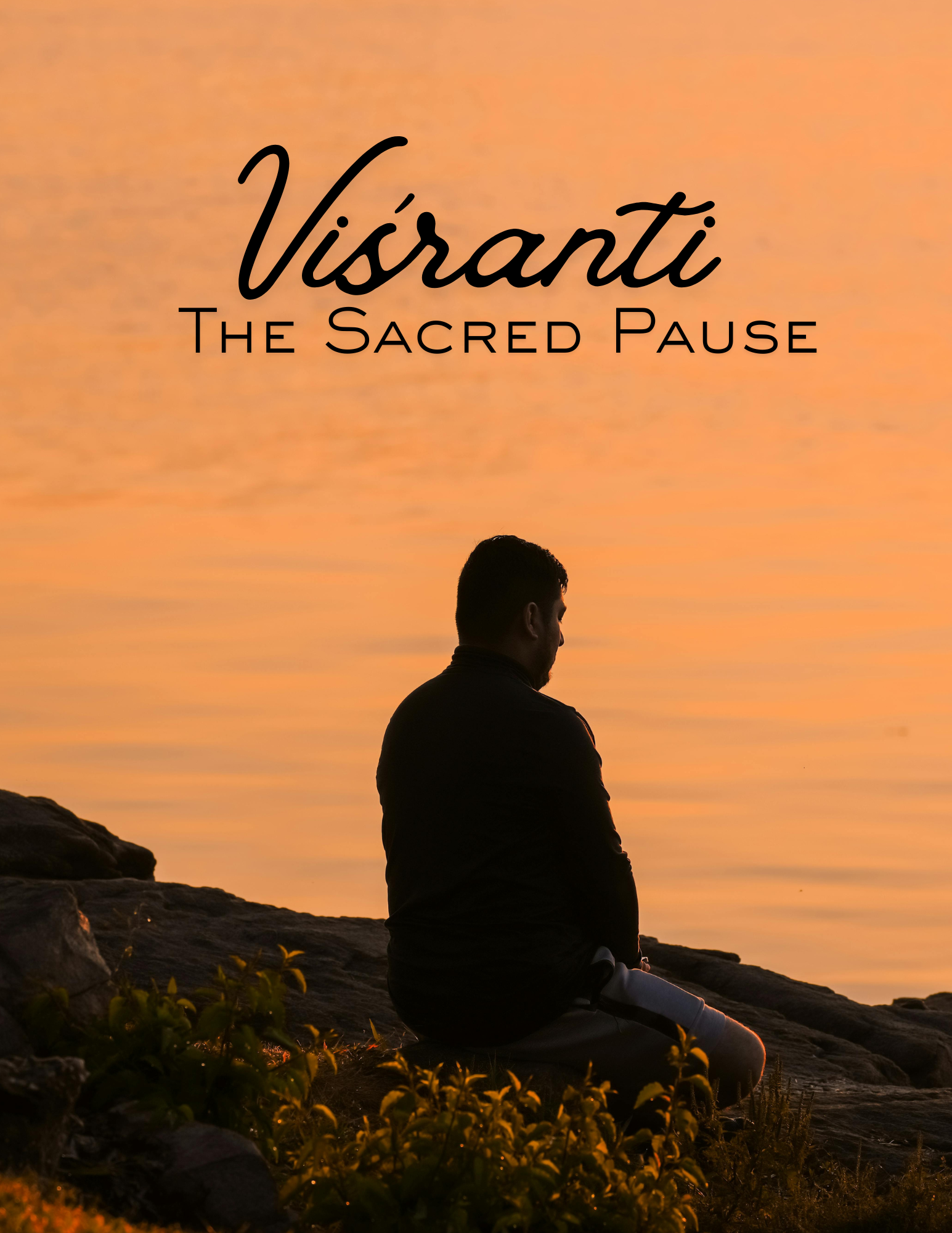
In the Tantric traditions, there is a beautiful concept called viśrānti. It’s commonly translated as rest or repose, but that doesn’t quite capture its depth. Viśrānti is not collapsing from exhaustion or checking out of life. It is a conscious resting within awareness — a deliberate pause where we allow ourselves to fully arrive. Viśrānti is more about resting our mind than resting our body.
When we fail to rest deeply, we don’t just feel tired. We lose clarity, steadiness, and our capacity to respond to life with wisdom.
Reducing Stimulation Is the First Step
Viśrānti begins with reducing stimuli. Stimuli include everything we take in through the five senses — not only what we dislike, but also what we enjoy and tolerate.
From a yogic perspective, all stimulation creates movement in the heart-mind (citta). Patanjali calls these movements vrttis. Vrttis are thoughts, emotions, memories, imaginings, reactions.
Vrttis are unavoidable. But too many of them cloud our perception and create confusion. This is why Patanjali defines yoga as:
Yoga is the stilling of the fluctuations of the heart-mind
(yogaś citta-vṛtti-nirodhaḥ)
As the tantric scholar/practitioner Hareesh Wallis says, “Imagine being in a crowded, noisy room and being asked to solve a difficult problem. Most of us would instinctively seek out a quieter space. But what if the noisy, crowded place is our own mind?” This is why the first step to truly resting in awareness is reducing the stimuli we expose ourselves to. If we want to make any progress on our spiritual path we must first be able to rest our mind.
How Much Should We Reduce?
Do we need to retreat to a cave in the Himalayas and isolate ourselves from the world? Not necessarily.
How much you reduce stimulation depends on how quickly you want to progress on your spiritual path, how much you want to stay engaged in your worldly life, and your unique constitution and circumstances.
A helpful starting point is simple and honest inquiry:
Which stimuli in my life uplift, inspire, and support me?
Which ones drain me, agitate me, or keep me stuck in compulsive patterns?
From there, experiment.
Try a partial stimulus fast — for example, taking a break from social media, television, or constant messaging. Often we discover that some things truly do nourish us in moderation, while others turn out to be habits of compulsion rather than genuine sources of joy.
This isn’t about rigid rules. It’s about degree.
Many sense pleasures — food, sex, entertainment, connection — can be healthy and life-affirming. But sometimes we need temporary separation from a stimulus to clearly see how much it supports us, and how much it undermines us.
“Message-bearing” stimuli — TV, internet, magazines, advertising, social media — are especially important to examine. Much of modern media presents artificial standards of what our bodies, relationships, and lives should look like. This kind of messaging directly interferes with yoga’s deeper aim: learning to hear and trust our own inner wisdom and to love reality as it is.
It’s no accident that many organized religions have established monastic environments, places where sensory stimulationcan be reduced without total isolation. The intention was to support clarity while still learning how to live with others.
Even for householders, some degree of renunciation is necessary — not because certain actions are “bad,” but because they impede meditation and inner freedom.
A Practice of Inquiry
Take time to contemplate:
What stimuli are not helping me progress — or may even be hindering me?
What obstacles make it difficult to let them go?
Am I willing to release them, even temporarily?
Make a specific plan:
What will you reduce or eliminate?
For how long?
How will you evaluate its effect on your body and mind?
Repeat this process regularly. Spiritual life is not static — it’s an ongoing refinement of relationship with your environment.
Taking Proper Rest: Not Optional
Reducing stimuli naturally leads us to the second pillar of viśrānti: proper rest.
At a basic level, this means:
7–9 hours of sleep per night
Taking rest during waking hours — time for fun, play, and enjoyment with no agenda — otherwise known as recreation
But proper rest also requires something deeper: letting go of the belief that maximum success comes from maximum effort. It means releasing scarcity consciousness—the persistent feeling that there is “not enough time.”
If you feel there is never enough time, it is a sign you are trying to do too much. The remedy is not pushing harder — it is simplifying.
We all need what Hareesh calls R&R&R: Rest, Relaxation, and Recreation.
Ideally, this looks like a full day each week devoted to doing nothing productive — no demands, no self-improvement projects, no agenda. This was the original purpose of the Sabbath. If a full day feels impossible, start with a half day and build from there.
If you believe you cannot afford time for rest, that is precisely when you cannot afford not to take it. Your health and well-being are at stake.
Relaxation is not separate from spiritual practice — it is a prerequisite. If you are not skilled at relaxation, meditation will remain elusive. This is one of the great gifts of yoga āsana: it teaches the body and nervous system how to let go so the mind can follow.
A One-Month Practice
For the next month:
Create a clear plan for reducing stimuli – less television, less social media, etc.
Commit to proper rest. Choose a specific amount of time each day and each week for rest and relaxation.
Reflect honestly:
What fears or anxieties prevent me from resting?
What am I afraid will happen if I slow down?
Write your reflections down, and then acknowledge the truth that you can address all of your fears more skillfully when you are rested and relaxed.
Viśrānti reminds us that before transformation, before clarity, there must be arrival. When we learn to rest deeply in awareness, we don’t fall behind in life. We finally catch up to ourselves.